The problem
A language model's factual knowledge is baked into its weights at training time. When a fact changes (a CEO steps down, an API is renamed) you have three bad options: retrain, which is absurdly expensive; fine-tune, which causes catastrophic forgetting; or surgically rewrite weights with methods like ROME and MEMIT, which is slow, and each edit degrades the model a little more.
INLAY takes a fourth path: don't touch the weights at all. The base model stays frozen. Edits live in an external memory addressed by semantic keys, and when a query matches a stored edit, the answer is played back in logit space over the frozen model's own decoding. Writing an edit is a memory insert with zero gradient steps, roughly 5 to 15 ms per edit. Deleting an edit is trivially exact, which no weight-editing method can offer.
What the benchmarks say
I evaluated INLAY against the published field (ROME, MEMIT, WISE, GRACE, AlphaEdit) plus fine-tuning and in-context (RAG) baselines, on the two standard editing benchmarks, across four model families (GPT-2-XL, GPT-J-6B, Qwen2.5-7B, Mistral-7B), at up to N=5000 edits with held-out gate selection.
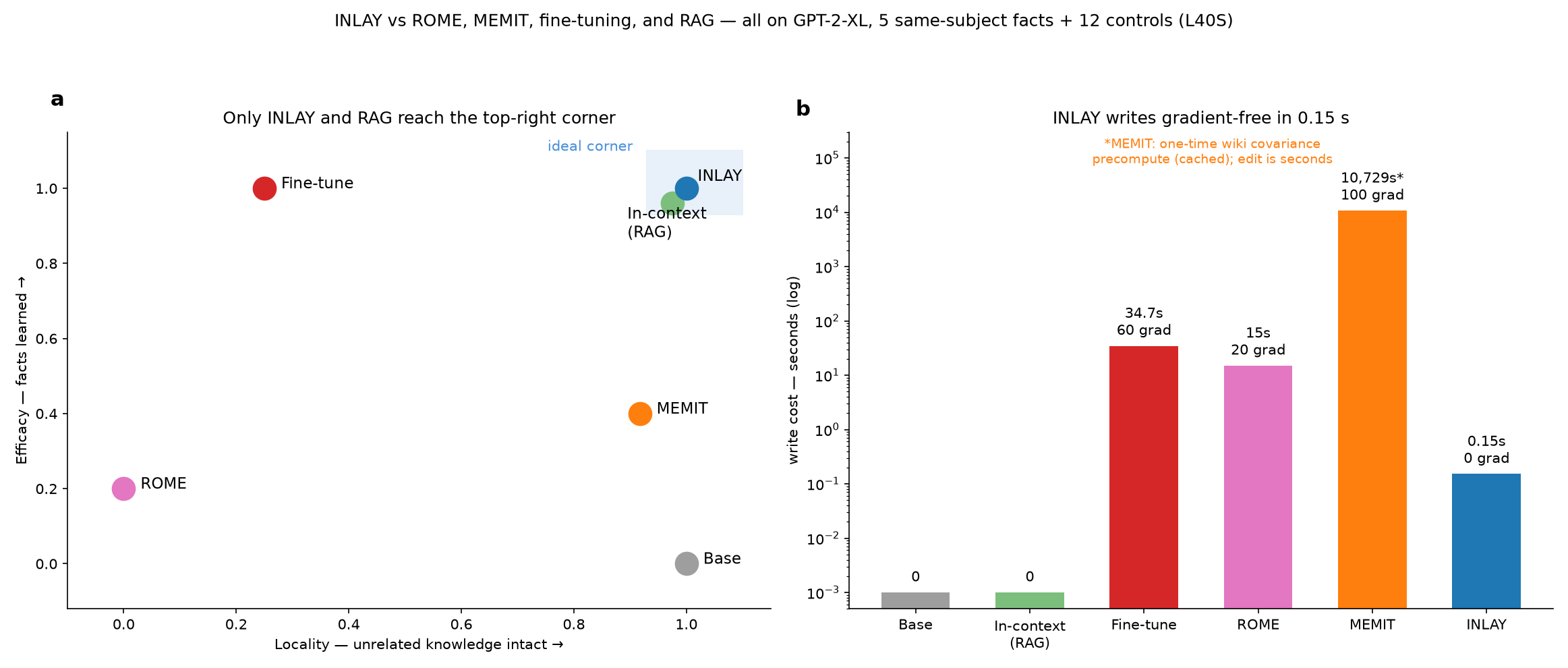
CounterFact (harmonic mean of efficacy, paraphrase, locality):
| Model | INLAY | ROME | WISE | AlphaEdit | MEMIT | GRACE |
|---|---|---|---|---|---|---|
| GPT-J-6B | 0.893 | 0.797 | 0.703 | 0.460 | 0.431 | 0.0 |
| Qwen2.5-7B | 0.894 | 0.777 | 0.947 | —* | —* | ~0.0 |
| Mistral-7B | 0.900 | 0.340† | — | — | — | — |
zsRE:
| Model | INLAY | WISE | ROME | AlphaEdit | MEMIT | GRACE |
|---|---|---|---|---|---|---|
| GPT-J-6B | 1.00 | 0.996 | 0.937 | 0.670 | 0.650 | 0.004 |
| Qwen2.5-7B | 0.996–1.00 | 0.999 | 0.975 | 0.682 | 0.682 | 0.056 |
| Mistral-7B | 1.00 | — | 0.702 | — | — | — |
Note the honest exception in the table: WISE beats INLAY on Qwen CounterFact (0.947 vs 0.894). One benchmark, one model, but it's real and it stays in the table.
The sequential stress test is where the architecture argument lands. Apply 400 edits one after another: ROME's locality collapses to zero by around 50 edits, effectively destroying the model, while INLAY's retention stays at 1.0 with locality degrading gently, at roughly 1600× lower write cost per edit:
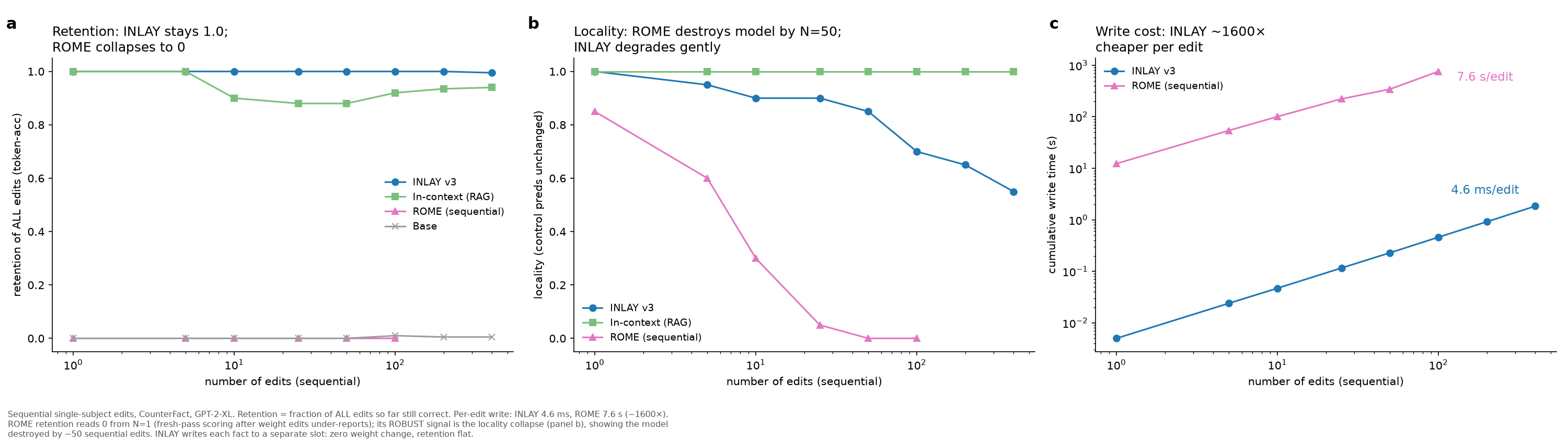
This isn't surprising once you see the mechanism: each INLAY edit is an isolated memory slot, so edits can't interfere with each other or with the base model. Weight editors compound damage; a memory table doesn't.
Current limitations, and what I'm doing about them
The current version stores answers and plays them back, which means it can't yet re-derive knowledge. Ask "Who is the CEO of X?" after editing it and INLAY answers correctly. Ask "Where did the CEO of X go to university?" and the stored answer alone isn't enough: the model needs to compose the edit with other knowledge, and the playback path doesn't give it that chance.
RippleEdits measures exactly this, and the current version loses there:
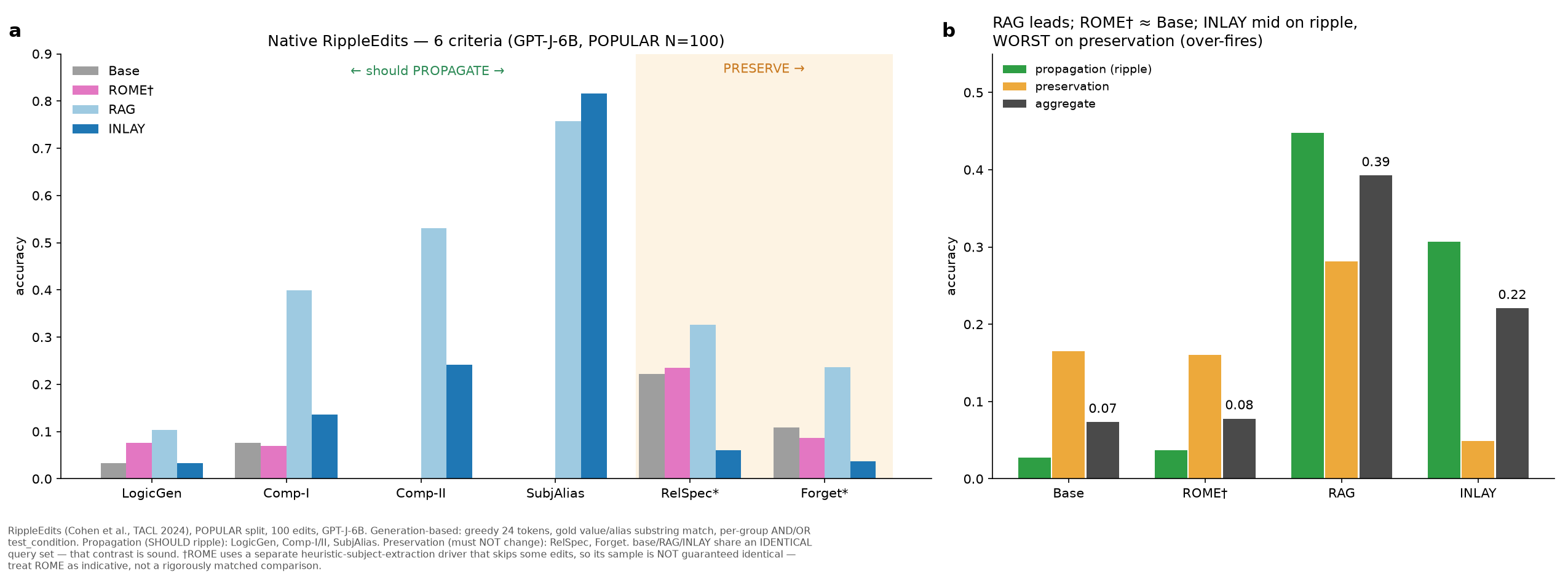
On the matched-manifest protocol (identical Wikidata-verified subjects for every method), in-context RAG scores 0.396 aggregate on GPT-J vs INLAY's 0.225, and INLAY is worst of all methods on preservation (0.05): its semantic keys over-fire on same-subject queries about different relations, overwriting facts that should have been left alone. A relation gate reduces over-firing from 0.97 to 0.67 but pays for it with paraphrase generalization.
These are limitations of the current playback design, not of the external-memory architecture, and they're what I'm actively working on now:
- One shared scope decision for every generation path. Today the playback path can bypass the relation gate. The redesign routes every query through a single router that returns reject, direct, or reason, so no path skips the scope check.
- A trained scope verifier with hard negatives. A small cross-encoder over question plus candidate edit, trained on exactly the failure cases the data exposes: same subject with a different relation, same relation with a different subject, stale answers. This follows the retrieval/scope separation SERAC pioneered.
- A reason mode instead of playback for compositional questions. When a query needs composition, retrieved edits become evidence in context and the frozen model generates the answer itself, in the spirit of in-context knowledge editing (IKE). Direct playback stays as the fast path for high-confidence atomic queries.
- A harder benchmark. The next evaluation target is AKEW, which tests structured facts, raw unstructured evidence, and extracted triples, plus multi-hop questions from MQuAKE.
The RippleEdits numbers above are the honest baseline this redesign has to beat.
Where it stands today
What's established, with every number traceable to a logged run:
- INLAY leads every measured baseline on single-edit CounterFact and zsRE on GPT-J and Mistral, and everything except WISE on Qwen, at three to four orders of magnitude lower write cost with zero gradient steps.
- The lead is sample-stable: going from N=100 to N=5000 moves the score by about 0.01.
- It's the only method in the comparison whose sequential retention stays flat.
What's not established yet, the open gaps I'm still running or haven't run:
- AlphaEdit on GPT-J CounterFact at N=2000 (job currently running).
- MEMIT/WISE/GRACE/AlphaEdit on Mistral, on any benchmark.
- Weight-editor baselines under the rigorous matched-manifest RippleEdits protocol; currently only base/RAG/INLAY have been through it.
- Sequential editing beyond GPT-2-XL.
- An apples-to-apples MEMIT/AlphaEdit number on Qwen CounterFact (only a different metric variant exists today).
The honest one-line summary: state of the art on the editing axes the field's leaderboards measure (efficacy, generalization, locality, sequential retention), with a named, measured limitation on compositional propagation in the current version, and a redesign in progress that targets exactly that axis.
Code, evaluation harnesses, and the full results audit are being prepared for release alongside a preprint. If you work on model editing and want to poke holes in this, please do: adipras1407@gmail.com.